

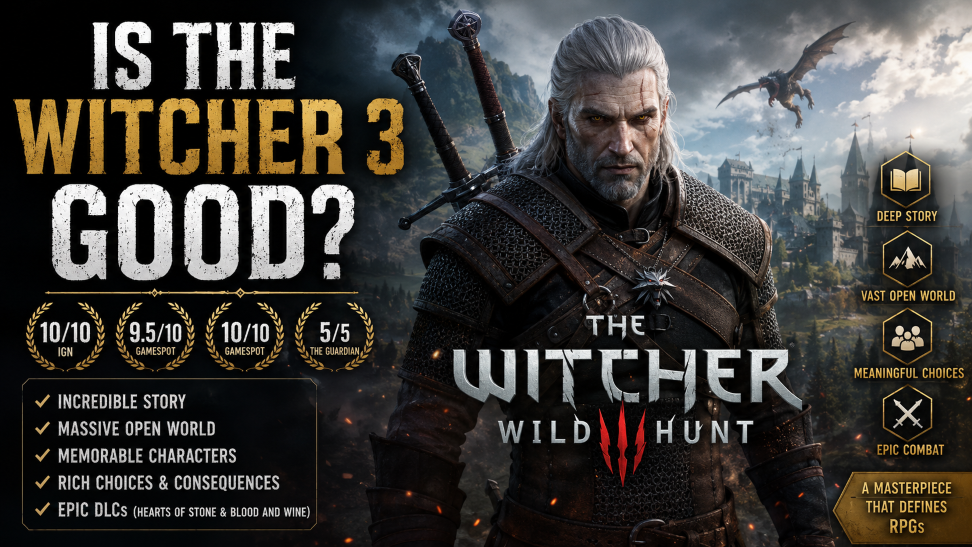
The Witcher 3: Wild Hunt is genuinely one of the best games ever made. That is not hype talking. Despite being nearly a decade old, the game is still regarded as one of the best RPGs of all time and holds up very well against newer titles in the genre. If you have been sitting on the fence about whether to play it, this article gives you the honest picture, the good, the frustrating, and everything in between.
What Kind of Game Is The Witcher 3?
The Witcher 3 is an open-world action RPG developed by CD Projekt Red. You step into the boots of Geralt of Rivia, a seasoned monster hunter who makes his living in a dark and unforgiving world. The game takes you on a quest to find Geralt’s adopted daughter Ciri, and the story tries to balance love, loss, loyalty, and existential dread in every dialogue and decision along the way.
The world you explore is massive. From the muddy villages of Velen to the Viking-inspired islands of Skellige, every region feels completely different in tone, weather, and culture. The game does not funnel you through a linear path. It drops you into this world and lets you decide how to move through it.
The Story Is the Main Reason to Play
If someone asks what makes The Witcher 3 special, the answer almost always comes back to the writing. The varied landscapes are filled with a cast of memorable characters with their own stories to tell, and all of this culminates in one of the best stories in video games.
What sets it apart from most RPGs is how the side quests are handled. In most games, side quests are optional filler. In The Witcher 3, many of them are better written than the main stories of other games entirely. The Bloody Baron questline alone, which you encounter very early in the game, has more emotional weight than most full games can manage.
Your choices matter here too. Not in a surface-level way where you pick dialogue options that lead to the same outcome. Decisions you make early in the game ripple forward in ways you genuinely do not see coming. Characters like Vesemir, Yennefer, Triss, and even NPCs in side quests have depth that gives every interaction significance.
How Does the Combat Feel?
This is where the honest conversation gets more complicated. Combat in The Witcher 3 is deceptively simple on the surface, but the deeper you go, the more it opens up. You have basic light and heavy attacks, five magical signs with different effects, bombs, crossbows, and a deep alchemy system for crafting potions and oils.
The combat works well. It is not the deepest system ever built, and players coming from action games with tight, responsive controls sometimes find it a little floaty at first. The graphics and voice acting are great, but the gameplay is a weaker point due to its simpler combat.
That said, on higher difficulty settings the game demands genuine preparation. You cannot button mash your way through hard fights. You need to read enemy weaknesses, apply the right oils to your sword, and use your signs strategically. When that preparation pays off and a difficult fight goes your way, it feels earned.
The Open World Is Overwhelming in the Best Way
The game is well optimized and performs much better than most modern games today. The world is enormous and packed with things to do, but the design is smart enough that very little of it feels like meaningless padding.
Question marks scattered across the map mark undiscovered locations. Some are abandoned sites with loot. Some are monster nests. Some unfold into something much bigger once you actually get there and see what is going on. The variety keeps exploration feeling worthwhile rather than repetitive.
The two expansion packs, Hearts of Stone and Blood and Wine, add dozens more hours of content and are considered by many players to be the best parts of the entire game. Blood and Wine especially introduces a new region called Toussaint that is visually unlike anything in the base game and tells a story that stands completely on its own.
Where The Witcher 3 Falls Short
Being honest means talking about the parts that do not work as well.
The inventory system is clunky. Managing loot, gear, and crafting materials becomes genuinely annoying as the game progresses. You will spend more time sorting through items than you probably want to.
The movement can feel stiff in combat compared to more modern action games. Geralt does not always go exactly where you want him to go, especially in tight spaces.
The open world question marks, while fun at first, can start to feel like a checklist after many hours of play. If you are the type of player who feels compelled to clear every icon on the map, the game can start to drag before you reach the end.
None of these issues are dealbreakers. They are friction points in an otherwise exceptional experience, and most players stop noticing them once the story pulls them in properly.
Is The Witcher 3 Good for First Time RPG Players?
The Witcher 3 is actually one of the more accessible RPGs despite its depth. The story does not require you to have played the previous Witcher games. Even if you have not played the first two games, The Witcher 3 stands as a storytelling masterpiece that is fully understandable on its own.
The difficulty settings are flexible. Story and Sword mode reduces combat challenge significantly and lets you focus on the narrative. Blood and Broken Bones and the highest setting, Death March, are for players who want the game to genuinely test them.
For someone completely new to RPGs, starting on Story and Sword and bumping up the difficulty once you find your footing is a perfectly reasonable approach. The game rewards curiosity and exploration far more than mechanical skill, so the story will carry you through even if the combat takes time to click.
Is The Witcher 3 Still Worth Playing in 2026?
The Witcher 3 is still worth playing in 2026, and the next-gen update has made the experience even better for new players picking it up today. The updated version includes improved visuals, ray tracing support, faster load times on modern consoles, and a new questline tied to the Netflix series.
Players who started their second playthrough recently report that it holds up very well and continues to feel fresh. That is a remarkable thing to say about a game released in 2015.
The price makes the decision even easier. The Complete Edition, which includes the base game and both expansions, regularly goes on sale for a fraction of its original price. For the amount of content you get, it is one of the best value purchases in gaming.
How Does It Compare to Baldur’s Gate 3 and Other Modern RPGs?
The comparison to Baldur’s Gate 3 comes up often since BG3 introduced a new generation of players to deep RPG storytelling. The two games are different in structure. BG3 is turn-based and built around the Dungeons and Dragons ruleset. The Witcher 3 is real-time action with a custom world and lore.
Both games are excellent at what they do. If you loved BG3’s writing and character depth, The Witcher 3 will give you a similar level of storytelling investment in a completely different package. If you loved Divinity Original Sin 2, the same applies.
The Witcher 3 does things no other RPG does quite as well in terms of making the world feel lived in and morally complicated. Geralt is not a hero saving the world. He is a man trying to find someone he loves, navigating a world that does not particularly care about right and wrong.
Final Verdict
The Witcher 3 is good. More than good. It is the kind of game that stays with you after you finish it, the kind you recommend to people without hesitation, and the kind that holds up no matter how many years pass.
The combat is not perfect. The inventory is messy. Some parts of the open world can feel repetitive if you try to do everything. None of that changes the fact that this game tells one of the best stories in the medium and builds a world that genuinely feels alive.
If you have been asking yourself whether The Witcher 3 is worth your time in 2026, the answer is yes. Start on a comfortable difficulty, follow the main quest, let the side quests pull you in naturally, and give it until the end of the Bloody Baron storyline before you make up your mind.
You will not ask that question again after that.
The Witcher 3 Wild Hunt Complete Edition is available on PC via Steam and GOG, PlayStation 4 and 5, Xbox One and Series X, and Nintendo Switch. The Complete Edition includes the base game plus the Hearts of Stone and Blood and Wine expansions.
FAQs
Is The Witcher 3 worth buying in 2026? Yes, without question. The game regularly goes on deep sale, and the Complete Edition with both expansions represents exceptional value. The next-gen update also means it looks and runs better than ever on modern hardware.
Do you need to play Witcher 1 and 2 before Witcher 3? No. The Witcher 3 tells a complete story that new players can follow without any prior knowledge of the series. The game provides enough context to understand the key characters and relationships from the start.
How long does it take to finish The Witcher 3? The main story takes around 50 hours. A thorough playthrough including most side quests runs between 100 and 150 hours. Including both expansions, complete runs can exceed 200 hours.
Is The Witcher 3 harder than other RPGs? On default difficulty, it is manageable for most players. On higher settings, it becomes genuinely demanding. The flexible difficulty options mean you can adjust the experience to match your skill level at any point during the game.
What platforms is The Witcher 3 available on? The Witcher 3 is available on PC, PlayStation 4, PlayStation 5, Xbox One, Xbox Series X and S, and Nintendo Switch. The next-gen version with updated visuals is available as a free upgrade for existing owners on PS5 and Xbox Series X.
