

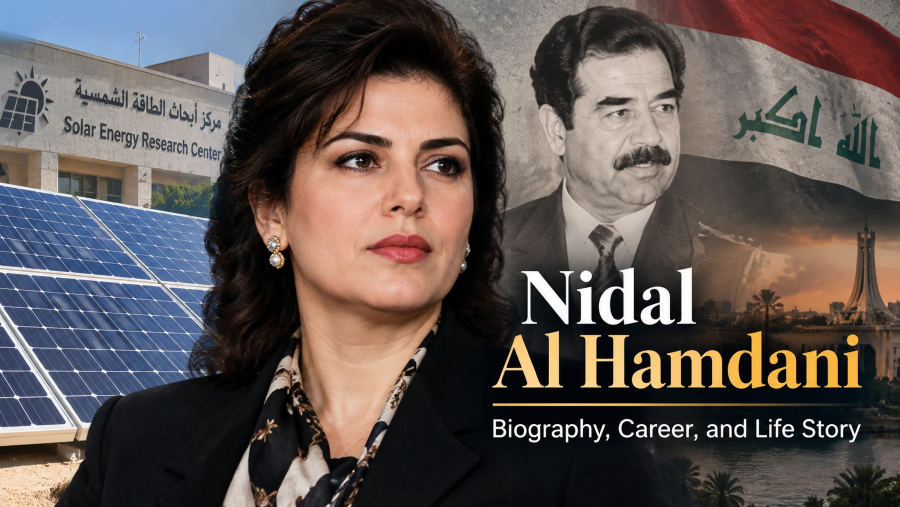
Nidal Al Hamdani is an Iraqi scientist and scientific administrator whose name is most often associated with Iraq’s solar-energy research sector and her reported marriage to former Iraqi president Saddam Hussein. Unlike many historical figures connected to Saddam’s government, Al Hamdani’s professional identity was rooted in science and research rather than politics. Public information about her early life, education, family, and later years, however, remains limited.
Available historical material identifies Dr. Nidal Al-Hamdani with Baghdad and Iraq’s scientific community. A publication from the International Association for Solar Energy Education also lists Dr. Nidal Al-Hamdani, Baghdad, Iraq, among its advisory committee members, providing a useful primary-era reference for her connection to solar-energy research.
Who Is Nidal Al Hamdani?
Nidal Al Hamdani is generally described as an Iraqi scientist who held a senior role within Iraq’s scientific research system. Several biographical accounts identify her as the general manager of the Solar Energy Research Center under Iraq’s Council of Scientific Research.
Her name later became widely known because of reports that she married Saddam Hussein around 1990. A CNN Editorial Research fact sheet republished by KRDO lists Nidal Al-Hamdani among Hussein’s marriages and gives 1990 as the beginning of the marriage.
The distinction between these two parts of her story is important. Her association with Saddam explains much of today’s online interest, but her reported scientific career provides a separate reason to examine her life.
Featured image alt text: Nidal Al Hamdani biography, Iraqi scientist and solar energy researcher
Nidal Al Hamdani’s Scientific Career
Role in Iraq’s Solar Energy Research
The most significant professional detail repeatedly associated with Nidal Al Hamdani is her reported leadership role at Iraq’s Solar Energy Research Center.
Sources describe the center as part of the country’s Council of Scientific Research, placing her within a state-supported scientific environment. Her name also appears in historical solar-energy material from the period, which makes the scientific aspect of her biography more than a recent internet invention.
However, claims about specific projects, team sizes, inventions, or individual research achievements should be treated cautiously unless supported by original scientific records. Many modern biographies repeat detailed claims without providing the underlying papers or institutional documents.
Why Her Scientific Background Matters
Nidal Al Hamdani’s professional background is significant because Iraq had an established scientific and technical research community during the twentieth century. Solar-energy research was part of the wider effort to investigate alternative energy technologies and applications.
Her inclusion in an international solar-energy organization’s historical material gives additional context to her professional identity. It suggests that her connection to solar research extended beyond later biographical articles written about her after the fall of Saddam Hussein’s government.
For readers researching Nidal Al Hamdani from the USA or UK, this is one of the most important gaps to understand: much of the online discussion concentrates on her reported marriage while comparatively little attention is given to the evidence connecting her to scientific organizations.
Early Life and Education
Reliable public information about Nidal Al Hamdani’s childhood is scarce. Her exact date of birth, birthplace, parents, siblings, and detailed family history are not consistently documented in accessible sources.
The same problem applies to her education. Some modern websites claim specific universities, degrees, or scientific specializations, but those details are not sufficiently supported by strong primary documentation to present them as established facts.
A responsible biography therefore needs to distinguish between documented professional references and repeated online claims.
Her appearance in historical solar-energy material provides stronger evidence for her professional connection to the field than unsupported claims about her childhood or university education.
Nidal Al Hamdani and Saddam Hussein
The Reported Marriage
The most widely searched aspect of Al Hamdani’s life is her reported relationship with Saddam Hussein.
CNN Editorial Research’s biographical information lists Nidal Al-Hamdani as one of Saddam Hussein’s wives beginning in 1990 and continuing until his death in 2006.
Other historical and biographical sources describe her as his alleged third wife.
Because independent documentation about the private marriage is limited, it is better to use careful language rather than presenting every detail repeated online as confirmed fact.
Why the Marriage Attracted Attention
The reported marriage connected a senior scientific professional with one of the most controversial political leaders of modern Iraqi history.
That connection transformed the way her name was discussed publicly. Instead of being remembered primarily for scientific work, she became a subject of interest to people researching Saddam Hussein’s family, private life, and inner circle.
This is also why searches from the UK, USA, and Lebanon can produce very different types of results. English-language websites often frame her story around Saddam Hussein, while historical or scientific references provide a different perspective on her professional identity.
What Happened to Nidal Al Hamdani After 2003?
There is no sufficiently reliable public record establishing Nidal Al Hamdani’s later location, career, or current personal circumstances.
After the 2003 invasion of Iraq and the collapse of Saddam Hussein’s government, information about her became particularly difficult to verify. Modern websites sometimes publish theories about where she may have gone, but theories should not be confused with documented evidence.
There is also no reliable basis for assigning her a current age or claiming a specific present-day location.
This is an important distinction for readers searching from the USA or UK: the absence of recent public information does not prove that a person has died, relocated, or assumed a different identity.
What Is Known and What Remains Uncertain?
| Topic | What can reasonably be established |
|---|---|
| Nationality | Iraqi |
| Professional field | Science and solar-energy research |
| Scientific connection | Associated with Iraq’s solar-energy research system |
| Baghdad connection | Historical solar-energy material lists Dr. Nidal Al-Hamdani in Baghdad |
| Reported marriage | CNN lists her as a wife of Saddam Hussein beginning in 1990 |
| Date of birth | Not reliably established in accessible sources |
| Education | Detailed academic record is not sufficiently documented |
| Children with Saddam | No children are listed in CNN’s summary of his children |
| Current whereabouts | Not reliably established |
The table illustrates why a careful approach is necessary. Some facts have stronger documentation than others.
Why Nidal Al Hamdani Is Still Searched Today
Interest in Nidal Al Hamdani comes from the unusual combination of science, Iraqi history, political power, and unanswered biographical questions.
People researching her may be looking for information about her scientific career, her reported relationship with Saddam Hussein, her age, her family, or what happened to her after 2003.
The strongest approach is not to fill missing information with speculation. Instead, readers should separate contemporary records from later online biographies and identify where evidence is actually available.
That evidence-first approach is particularly important for historical biographies because repeated claims can easily appear more credible simply because several websites copy the same information.
Nidal Al Hamdani’s Legacy
Nidal Al Hamdani’s legacy is difficult to reduce to a single description.
She is remembered in online historical discussions largely because of her reported connection to Saddam Hussein, but historical solar-energy material also places her within Iraq’s scientific community.
That professional connection deserves attention because it provides a more complete picture of her identity. She should not be discussed only as a political leader’s wife when there is historical material connecting her name with scientific organizations.
At the same time, claims about specific scientific achievements should be supported by original research papers, institutional records, or contemporary documentation before being treated as fact.
Internal linking suggestions:
- Link ExposedGame homepage to the site’s homepage from the introduction or conclusion.
- Link history and biography articles to a relevant existing ExposedGame article about historical figures or notable personalities.
- Link entertainment and celebrity guides to another relevant existing article on ExposedGame.
- Link Contact Us from the final section using the site’s existing contact page.
Frequently Asked Questions About Nidal Al Hamdani
Who was Nidal Al Hamdani?
Nidal Al Hamdani was an Iraqi scientist and scientific administrator associated with Iraq’s solar-energy research sector. She is also widely discussed because of her reported marriage to Saddam Hussein.
Was Nidal Al Hamdani a scientist?
Yes. Historical material connects Dr. Nidal Al-Hamdani with solar-energy research, and modern biographical sources identify her as a scientist and research administrator.
Was Nidal Al Hamdani married to Saddam Hussein?
CNN Editorial Research lists Nidal Al-Hamdani among Saddam Hussein’s wives beginning in 1990. Other sources describe her as his alleged third wife.
Did Nidal Al Hamdani have children?
CNN’s biographical summary of Saddam Hussein lists children associated with his other reported marriages but does not list children with Nidal Al-Hamdani. This should not be interpreted as proof about her entire family life.
How old is Nidal Al Hamdani?
Her exact date of birth and age are not reliably established in the publicly available sources reviewed. Online estimates should therefore be treated as speculation unless supported by primary documentation.
Where is Nidal Al Hamdani now?
Her current whereabouts have not been reliably established through strong public sources. Claims about her present location should not be treated as confirmed without credible evidence.
Is Nidal Al Hamdani still alive?
There is insufficient reliable public information to confirm her current status. The lack of recent information should not automatically be interpreted as evidence of death.
Why is Nidal Al Hamdani famous?
Her public profile comes from two different areas: her reported position in Iraq’s solar-energy research system and her reported marriage to Saddam Hussein. The latter is responsible for much of the current online interest in her name.
Final Thoughts
The story of Nidal Al Hamdani is best understood by separating documented information from claims that have accumulated online over time. Historical solar-energy material connects her with Iraq’s scientific community, while CNN’s biographical research identifies her as a wife of Saddam Hussein beginning in 1990.
Her early life, education, later whereabouts, and several personal details remain insufficiently documented. For readers in the USA, UK, Lebanon, and elsewhere, the most reliable way to research her is to prioritize contemporary records and credible historical sources instead of repeating unsupported claims.
External sources for further verification: CNN Editorial Research fact sheet and the historical International Association for Solar Energy Education material.
Author
Written by Sawyer Eli | I have been in the marketing industry for 7 years and have a good amount of experience working with companies to help them grow their social media presence. My expertise is content creation and management, as well as social media strategy. I’m also an expert at SEO, PPC, and email marketing.
