

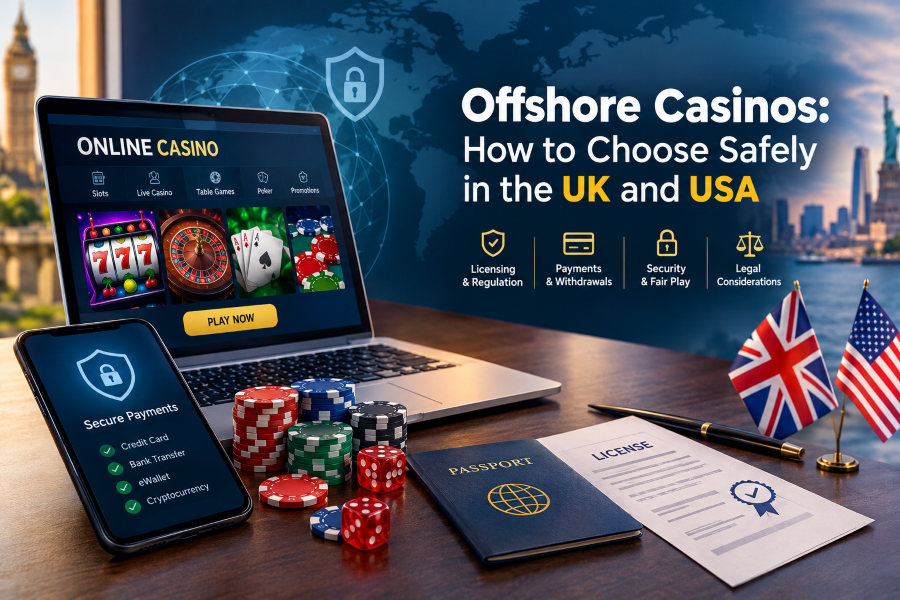
Offshore casinos are online gambling platforms licensed or operated outside the country where a player lives. People searching for offshore casinos often want a wider choice of casino games, different payment methods or access to platforms unavailable through local operators. However, an overseas licence does not automatically make a casino legal to use in every country, guarantee fair treatment or ensure that withdrawals will be paid.
Before comparing the best offshore casinos, players in the United Kingdom and United States should check local gambling laws, the operator’s licence, withdrawal conditions, identity verification requirements and dispute-resolution options. The safest choice is a properly licensed operator that is authorised to accept customers in the player’s location. Where offshore gambling is prohibited or the operator is not authorised locally, choosing a licensed domestic alternative is the better decision.
What Are Offshore Casinos?
Offshore casinos operate under a gambling licence or business registration in a jurisdiction outside the player’s home country. Depending on the operator, the licensing jurisdiction might have its own regulator, player-protection rules, complaint process and requirements for responsible gambling.
The term offshore does not describe a single level of quality. Some operators hold licences from established gambling regulators, while others provide little verifiable information about their ownership, oversight or financial practices. A website displaying a licence logo is not sufficient proof that the licence is genuine or covers the games being offered.
How Do Offshore Online Casinos Work?
Players generally create an account, complete any required identity checks, deposit funds and access games through a browser or mobile device. Deposits and withdrawals may be processed through cards, bank transfers, e-wallets or other payment services, depending on the operator and the player’s country.
An important distinction is that a casino’s advertised payment methods may not be available to every customer. Payment providers can restrict gambling transactions, and an operator may apply different withdrawal limits, fees or verification requirements by region.
How to Evaluate the Best Offshore Casinos
There is no universally best offshore casino for every player. A useful comparison focuses on verifiable licensing, legal access, financial transparency and practical customer protections rather than promotional bonuses alone.
1. Verify the Gambling Licence
Find the operator’s legal company name, licence number and regulator. Then visit the regulator’s official website to check whether the licence exists, remains active and covers the relevant gambling activities. Confirm that the company operating the website matches the information in the register.
Do not assume that a licence from one jurisdiction permits the operator to serve customers worldwide. Some licences have limited territorial scope, and a casino may exclude particular countries in its terms.
2. Read Withdrawal and Bonus Terms
Promotions can look attractive while carrying conditions that make withdrawals difficult. Review wagering requirements, maximum bet rules during bonus play, expiry dates, eligible games, withdrawal caps and any restrictions on promotional funds.
Check the standard withdrawal process separately from the bonus offer. Look for minimum and maximum withdrawal amounts, processing times, identity-document requirements and fees. Unclear terms or unexplained changes to withdrawal conditions are reasons to avoid depositing money.
3. Check Independent Oversight and Complaints
Look for a named regulator and a documented process for raising complaints. Determine whether the operator offers access to an independent dispute-resolution service and whether that service actually covers the casino and the type of complaint involved.
Customer reviews may help identify recurring reports about delayed payments or poor support, but individual reviews are not conclusive evidence. Give more weight to verifiable regulatory records, published enforcement decisions and clearly documented terms.
4. Assess Security and Responsible Gambling Tools
A reputable operator should explain how it protects account information, handles identity documents and secures transactions. It should also provide meaningful tools such as deposit limits, time-outs, self-exclusion and access to account activity.
Security technology alone cannot prove that a casino is trustworthy. A secure connection protects data in transit, but it does not establish that the business is licensed, financially reliable or legally available in your location.
Are Offshore Casinos Legal in the USA?
The legality of offshore online casinos in the United States depends on federal law, state law, the type of gambling offered and the operator’s authorisation. Online casino gambling is not regulated through one uniform nationwide licensing system that permits every offshore website to accept American customers.
Some states permit licensed online casino gambling, while others do not authorise the same products. An offshore operator accepting US dollars or allowing account registration does not prove that it can lawfully serve a customer in a particular state.
What US Players Should Check
- State law: Confirm whether online casino gambling is permitted where you live.
- Operator authorisation: Check the relevant state gambling regulator’s list of licensed operators.
- Payment restrictions: Your bank or payment provider may block gambling transactions.
- Tax responsibilities: Gambling winnings can have tax implications. Consult the IRS and applicable state tax guidance for your circumstances.
For authoritative information, start with the IRS for federal tax matters and the official gambling regulator for your state. If an offshore website is not authorised to serve your location, do not treat its accessibility as evidence of legality.
Are Offshore Casinos Legal in the UK?
In the United Kingdom, the Gambling Commission regulates licensed gambling operators. A website being based overseas does not automatically exempt it from UK requirements when it offers gambling to consumers in Great Britain.
UK players should check whether the operator is licensed by the UK Gambling Commission. Search the official register using the business name rather than relying only on a logo displayed on the casino website.
Licensed operators must meet applicable regulatory requirements, including rules relating to customer protection and responsible gambling. An offshore site without the necessary authorisation may leave players with fewer practical options if a dispute arises. Before opening an account, verify the operator’s status and avoid sites that deliberately obscure their ownership or licensing information.
Offshore Casino Payments and Withdrawals
Payment convenience should never outweigh legality and financial security. Offshore casinos may advertise several ways to deposit, but availability depends on location, provider policies and the casino’s own terms.
Common Payment Considerations
| Payment method | What to check |
|---|---|
| Bank card | Whether gambling transactions are permitted and what fees apply |
| Bank transfer | Processing times, transfer restrictions and recipient details |
| E-wallet | Provider rules, account eligibility and withdrawal support |
| Cryptocurrency | Price volatility, transaction irreversibility and limited recovery options |
A deposit being successful does not guarantee that a later withdrawal will be approved. Casinos may require identity verification, proof of address, payment-source checks or additional documentation before releasing funds. Never send money to a personal account or pay an unexpected extra fee on the promise that it will unlock a withdrawal.
Common Risks of Offshore Online Casinos
The main risks include unclear legal status, weak complaint options, misleading promotions, restricted withdrawals and misuse of personal information. Players may also encounter websites that copy legitimate brands or display fabricated licensing details.
Be especially cautious if an operator promises guaranteed winnings, pressures you to deposit quickly, asks for your account password or requests additional payments to release existing funds. These are serious warning signs, not ordinary reasons to trust a platform.
Before registering, read the terms, verify the licence independently and establish how complaints can be escalated. If you cannot confirm these details, do not deposit.
Frequently Asked Questions
What are offshore casinos?
Offshore casinos are online gambling platforms licensed or operated outside a player’s home country. Their legal status depends on the operator’s authorisation and the laws that apply where the player lives.
Are offshore casinos legal in the USA?
There is no single answer for every state. Online casino gambling laws and licensing requirements vary, so players should consult their state regulator and avoid operators that are not authorised to serve their location.
Can UK residents use offshore online casinos?
UK residents should verify whether an operator holds the appropriate UK Gambling Commission licence. A foreign licence alone does not establish that the operator is authorised to offer gambling to consumers in Great Britain.
Are offshore casinos safe?
Safety cannot be determined by the word offshore or by a website’s appearance. Verify the licence, legal company, withdrawal terms, security practices and complaint process before considering any operator.
Do offshore casinos always pay withdrawals?
No. Withdrawal outcomes depend on the operator’s terms, verification checks, account status and applicable laws. No licence or promotional claim guarantees that every withdrawal will be completed without a dispute.
Are offshore casino bonuses worth claiming?
Only consider a bonus after reading its full terms, including wagering requirements, eligible games, expiry dates and withdrawal restrictions. A large advertised bonus can be less useful than a transparent offer with manageable conditions.
Does using cryptocurrency make offshore gambling legal?
No. The payment method does not determine whether the gambling activity or operator is legal. Cryptocurrency can also introduce volatility and transaction-recovery risks.
Final Thoughts
Offshore casinos should be evaluated through licensing, local legality, transparent financial terms and meaningful player protections, not just game selection or bonus size. UK and US players face different regulatory requirements, so checking the rules for the exact location is an essential first step.
For more gaming guides and online entertainment articles, visit Exposed Game. Explore the site’s relevant gaming guides before choosing your next activity, and use official regulatory sources whenever a decision involves real-money gambling.
Editorial note: This article is informational, not legal or financial advice. Gambling involves financial risk, and readers should follow local laws and use responsible-gambling tools.
Suggested internal links for ExposedGame.com
- Homepage: Exposed Game – link the brand mention in the introduction or conclusion.
- Relevant gaming guide: add the actual URL of an existing online gaming guide where the article discusses game selection.
- Browser games article: add the actual URL of an existing free online games or browser games page.
- Contact page: add the site’s verified Contact Us URL for editorial questions. Confirm the URL before publishing; do not create a link to a page that does not exist.
Suggested external citations
- UK Gambling Commission – verify licensing and the regulatory status of operators serving Great Britain.
- Internal Revenue Service – consult official US federal tax guidance relevant to gambling winnings.
- For US legality, add a link to the official gambling regulator in the specific state being discussed, rather than treating the rules as identical nationwide.
Featured image alt text: Offshore casinos guide explaining licensing, payment security and legal checks for UK and USA players.
Written by Sawyer Eli | I have been in the marketing industry for 7 years and have a good amount of experience working with companies to help them grow their social media presence. My expertise is content creation and management, as well as social media strategy. I’m also an expert at SEO, PPC, and email marketing.
